Your Menstrual Cycle and Digestion: Why Bloating and Bowel Habits Change

Written by: Zahra Tromness, RD, MHSc, APD, FMN
Updated: November 2nd, 2026
Bloated the week before your period? Running to the bathroom on day one? These changes are very common, and they are closely tied to the link between the menstrual cycle and digestion.
The hormones that run your cycle also act on your gut. This article explains what happens to your gut at each stage of the month, what may help, and which symptoms are worth checking with a healthcare provider.
Quick Answer: Yes, your menstrual cycle can affect digestion. Estrogen and progesterone act on the gut, so bowel habits and bloating may shift through the month. Many people notice constipation and bloating in the days before a period, then looser, more frequent stools once bleeding starts. Tracking symptoms against your cycle for two or three months may help you see your own pattern.
Hormones and digestion: how your cycle talks to your gut
Your gut has receptors for two main hormones, estrogen and progesterone. Receptors work like docking points for hormones. They sit in the muscle of the bowel wall and in the nerves that control it (Li et al., 2026). When hormone levels rise and fall, the signals your gut receives change too.
Speed: how fast food moves through
Progesterone relaxes smooth muscle, the type of muscle that lines the bowel. When progesterone is high, research suggests that food and stool may move more slowly. Slower movement is linked with constipation and a full, heavy feeling.
Sensitivity: how strongly you feel it
Hormone changes may also turn up the volume on signals from the gut. The same amount of gas can feel like much more. This helps explain why bloating can feel intense even when little has changed inside.
What happens to digestion at each stage of the cycle
Use this table as a general guide. Experiences vary, and some people notice very little change.
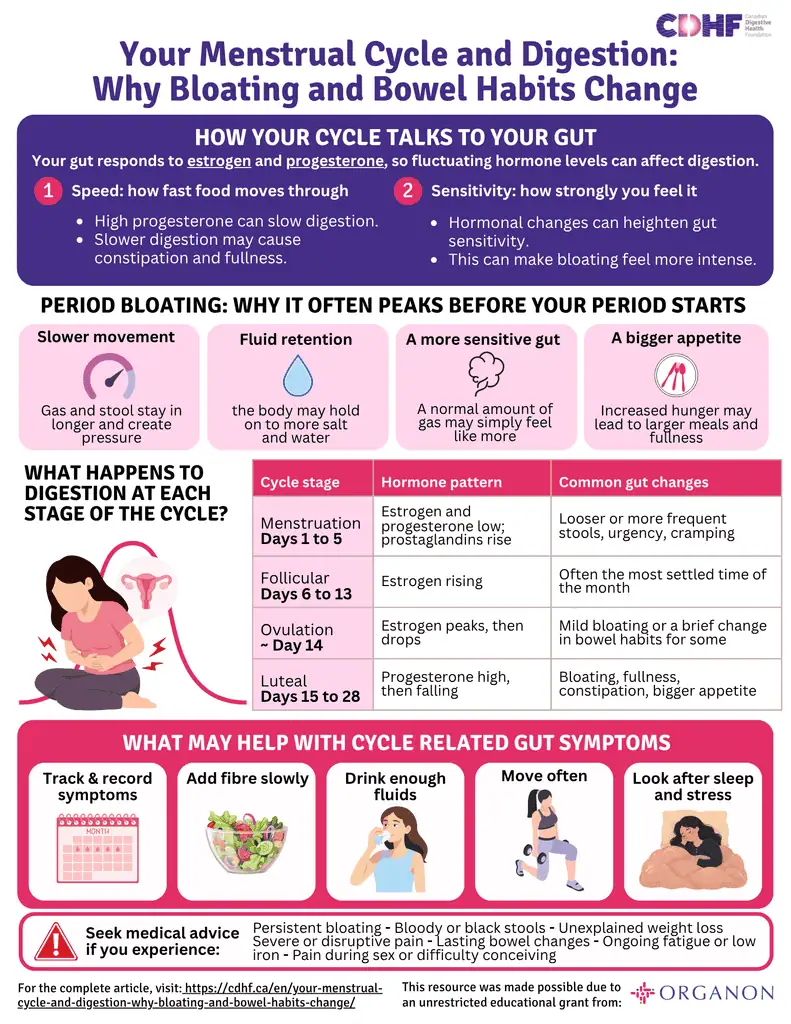
| Cycle stage | Roughly when | Hormone pattern | Common gut changes |
| Menstruation | Days 1 to 5 | Estrogen and progesterone low; prostaglandins rise | Looser or more frequent stools, urgency, cramping |
| Follicular | Days 6 to 13 | Estrogen rising | Often the most settled time of the month |
| Ovulation | Around day 14 | Estrogen peaks, then drops | Mild bloating or a brief change in bowel habits for some |
| Luteal | Days 15 to 28 | Progesterone high, then falling | Bloating, fullness, constipation, bigger appetite |
The days above assume a 28 day cycle. In adults, a cycle anywhere from 21 to 35 days is generally considered typical. Count the first day of bleeding as day 1. If your cycle is shorter or longer, the order of the stages stays the same. Only the timing shifts.
Bottom line: For many people, the days before a period bring a slower, fuller gut. The first days of a period often bring the opposite. Knowing which stage you are in can make symptoms feel far less random.
Period bloating: why it often peaks before your period starts
Period bloating is one of the most common symptoms of the luteal phase, the week or two before a period. Constipation before a period is common at this stage too. Several things may be happening at once:
- Slower movement. Higher progesterone may slow the bowel, so gas and stool stay in longer and create pressure.
- Fluid retention. Hormone shifts may lead the body to hold on to more salt and water. This adds to a swollen feeling.
- A more sensitive gut. A normal amount of gas may simply feel like more.
- A bigger appetite. Hunger often rises before a period. Larger meals can add to fullness when the gut is already moving more slowly.
Why your belly can look bigger by evening
Many people say their belly looks visibly bigger by the end of the day, sometimes enough to change how clothes fit. Research helps explain why. In some people with bloating, the belly wall muscles relax while the diaphragm, the breathing muscle under the lungs, pushes down (Moshiree et al., 2023). This reflex is called abdominophrenic dyssynergia.
So, the belly changes shape even without much extra gas inside. Breathing techniques, and sometimes biofeedback with a trained therapist, may help.
Bowel changes during your period: why they happen
Just before and during a period, the uterus releases prostaglandins. Prostaglandins are chemical messengers that help the uterus contract. They may also stimulate the nearby bowel (Bharadwaj et al., 2015), which may explain looser, more urgent stools on the first day or two.
For most people, this settles within a couple of days. If it disrupts your work, school or daily life, please talk to a healthcare provider rather than simply putting up with it.
Menstrual cycle and digestion when you have IBS or IBD
If you live with irritable bowel syndrome (IBS) or inflammatory bowel disease (IBD), your cycle may add to the symptoms you already have. Many women with IBS notice their symptoms get worse around their period, with more bloating, cramping and changes in bowel habits. Learn more in CDHF’s guide to IBS in women. People with IBD may also notice more gut symptoms before and during their period, although findings vary between studies.
If you notice a monthly pattern, share it with your healthcare team. It may change how and when your management plan is used across the month.
What may help with cycle related gut symptoms
No single fix works for everyone. These steps are practical and low risk, and work best alongside advice from your own healthcare provider.
- Track first. For two or three cycles, write down your symptoms and the day of your cycle. Patterns that feel random often turn out to be predictable, and a record is far more useful to your provider than memory.
- Add fibre slowly. If constipation builds before your period, a gradual increase in fibre may help. Big, sudden increases often make bloating worse. CDHF’s guide to fibre and its benefits can give you some good ideas.
- Drink enough fluid. Fluid helps keep stool soft, especially when you add fibre.
- Move often. Physical activity is linked with better gut movement. Even short walks, especially after meals, may help on sluggish days.
- Eat smaller meals, slowly. Large or rushed meals may add to fullness when the gut is already slower.
- Look after sleep and stress. The gut and the brain are closely connected, and stress is linked with worse gut symptoms.
Bottom line: The goal is to ease the symptoms that get in the way of daily life, so they no longer catch you off guard.
When to see a healthcare provider
Gut changes that follow your cycles are common. Some symptoms should always be checked rather than blamed on hormones. Speak with a healthcare provider if you notice:
- Bloating most days that does not ease at any point in your cycle
- Blood in your stool, or black stools
- Weight loss you cannot explain
- Pain that disrupts sleep, work or daily life, or period pain your usual measures do not control
- A change in bowel habits that continues after your period ends
- Ongoing tiredness or signs of low iron
- Pain during sex or trouble getting pregnant along with bowel symptoms
Painful periods with bowel symptoms can also be a sign of endometriosis. This is a condition where tissue similar to the lining of the uterus grows outside it. Neither condition is the likely cause for most people, but both are worth ruling out.
If you have concerns about bloating or pain, always consult your healthcare professional.
Putting it all together
Your menstrual cycle and digestion are closely connected. Hormone shifts can change how fast your gut moves and how strongly you feel it. Tracking your symptoms, adjusting fibre slowly and knowing which signs need a check can make a real difference.
Understanding your monthly rhythm is the foundation. But what happens when that rhythm starts to change? The next article in this series looks at perimenopause, a stage when new gut symptoms often appear with very little explanation.
Key takeaways
- Estrogen and progesterone act on the gut, so bloating and bowel habits may change across the month.
- The week or two before a period is often linked with slower movement, constipation and bloating.
- Prostaglandins released around a period may stimulate the bowel and cause looser stools.
- Tracking symptoms against your cycle for two or three months may reveal a clear, manageable pattern.
- Bloating most days, blood in the stool, weight loss or severe pain always need a medical check.
Frequently asked questions
Is it normal to be constipated before your period?
Yes, it is common. Progesterone rises after ovulation and may slow movement through the bowel. This can make stools harder and less frequent until your period starts.
Why do I get diarrhea on the first day of my period?
Prostaglandins are the likely reason. These chemical messengers help the uterus contract, and they may also stimulate the nearby bowel. This can cause looser, more frequent stools for a day or two.
Is period bloating different from bloating after a meal?
Yes. Bloating after a meal is often linked to what you ate and usually settles within hours. Period bloating may involve slower gut movement, fluid retention and a more sensitive gut, so it can build over several days.
Does hormonal birth control affect digestion?
It may. Hormonal birth control changes your hormone pattern across the month. Some people find their gut symptoms settle, some notice new changes, and many notice no difference. Talk to your prescriber if you notice a change.
When should period bloating be checked by a doctor?
When it no longer comes and goes. Bloating that is there most days, or bloating with blood in the stool, unexplained weight loss or severe pain, should always be checked by a healthcare provider.
Read the rest of the articles in this series:


This resource was made possible due to an unrestricted educational grant from Organon.

References
- Bharadwaj, S., Barber, M. D., Graff, L. A., & Shen, B. (2015). Symptomatology of irritable bowel syndrome and inflammatory bowel disease during the menstrual cycle. Gastroenterology Report, 3(3), 185–193. https://doi.org/10.1093/gastro/gov010
- Canadian Cancer Society. (2025). Symptoms of ovarian cancer. https://cancer.ca/en/cancer-information/cancer-types/ovarian/signs-and-symptoms
- Canadian Digestive Health Foundation. (2022). Fibre & its benefits. https://cdhf.ca/en/fibre-and-its-benefits/
- Canadian Digestive Health Foundation. (2025). IBS in women. https://cdhf.ca/en/ibs-in-women/
- Li, Z., Zheng, Y., Shen, F., & Zhou, X. (2026). Sex hormones and functional gastrointestinal disorders in menopausal women. Frontiers in Endocrinology, 17, Article 1679338. https://doi.org/10.3389/fendo.2026.1679338
- Malinauskiene, V., Zuzo, A., Liakina, V., Kazenaite, E., & Stundiene, I. (2023). Menstrual cycle abnormalities in women with inflammatory bowel disease and effects of biological therapy on gynecological pathology. World Journal of Clinical Cases, 11(21), 4989–4995. https://doi.org/10.12998/wjcc.v11.i21.4989
- Moshiree, B., Drossman, D., & Shaukat, A. (2023). AGA clinical practice update on evaluation and treatment of belching, abdominal bloating, and distention: Expert review. Gastroenterology, 165(3), 791–800. https://doi.org/10.1053/j.gastro.2023.04.039
- Prior, J. C. (2022, February 2). What’s normal: The important issue of cycle length. Centre for Menstrual Cycle and Ovulation Research, University of British Columbia. https://cemcor.ubc.ca/?p=1663
- Singh, S. S., Allaire, C., Al-Nourhji, O., Bougie, O., Bridge-Cook, P., Duigenan, S., Kroft, J., Lemyre, M., Leonardi, M., Leyland, N., Maheux-Lacroix, S., Wessels, J., Wahl, K., & Yong, P. J. (2024). Guideline No. 449: Diagnosis and impact of endometriosis. A Canadian guideline. Journal of Obstetrics and Gynaecology Canada, 46(5), Article 102450. https://doi.org/10.1016/j.jogc.2024.102450