
Menopause Nutrition: Eating Well for Your Gut and Long-Term Health

Written by: Zahra Tromness, RD, MHSc, APD, FMN
Updated: November 2nd, 2026
After perimenopause, many women find their gut symptoms become more predictable. That makes it a good time to focus on menopause nutrition that works on more than one front. The same eating habits that may ease constipation and bloating also support your bones, your heart and your long term health.
This article covers the link between menopause and gut health, which eating habits may help your gut most, and how healthy eating after menopause also protects your bones and heart.
Quick Answer: Good menopause nutrition for gut health focuses on fibre from a variety of plant foods, enough fluid, regular meals, enough protein, and daily movement. These habits may ease constipation and bloating, which often become more common with age. The same pattern, with enough calcium and vitamin D, also supports bone and heart health. Most women need variety, not a restrictive diet.
Menopause and gut health: what changes
Menopause is reached after 12 months in a row without a period. After that, estrogen and progesterone stay low and fairly steady. For many women, that steadiness brings relief after the ups and downs of perimenopause. Some gut changes are still common:
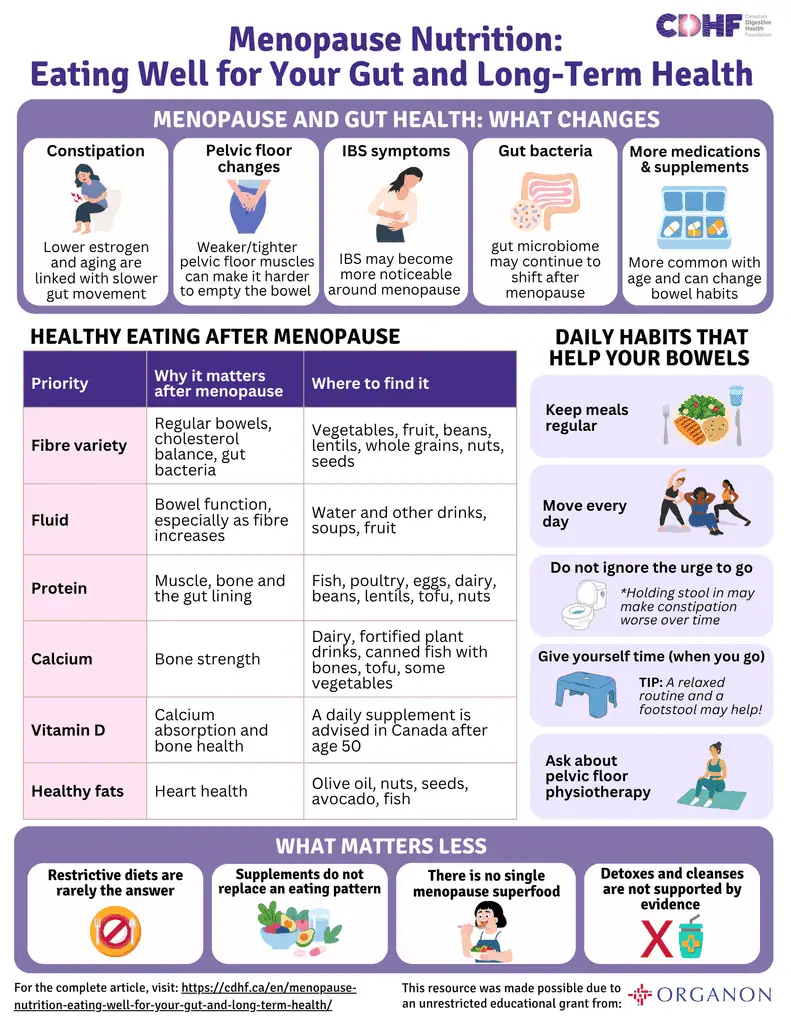
- Constipation. Lower estrogen and aging are linked with slower gut movement, so constipation is reported more often (Li et al., 2026).
- Pelvic floor changes. Weaker or tighter pelvic floor muscles can make it harder to empty the bowel (Women’s Health Concern, 2025).
- IBS symptoms. For some women, IBS may become more noticeable around menopause (Women’s Health Concern, 2025).
- Gut bacteria. The gut microbiome may continue to shift after menopause, although research is still early (Wang et al., 2025).
- More medications and supplements. These become more common with age, and some can change bowel habits.
Bottom line: After menopause, gut symptoms are often more predictable, but they do not always ease. The same daily habits can help your gut, bones and heart at once.
Fibre during menopause: the most useful place to start
If you make one change, make it fibre from a wide variety of plant foods. Fibre during menopause and beyond matters even more as the gut slows.
Fibre supports regular bowel movements. It feeds helpful gut bacteria. It is also linked with better cholesterol and blood sugar levels, which matter for heart health after menopause.
Health Canada recommends 25 grams of fibre a day for women. Most Canadians get only about half that, so there is usually room to build. CDHF’s guide to fibre and its benefits is a helpful companion to this section.
How to add fibre without more bloating
- Go slowly. Add one new fibre food at a time and give your gut a week or two to adjust.
- Add fluid too. Fibre works best with enough fluid. More fibre without more fluid may make constipation worse.
- Aim for variety. Different plants feed different gut bacteria. A wide range across the week may matter more than a large amount of one food.
- Mix your sources. Oats, beans and lentils, fruit, vegetables, nuts, seeds and whole grains each bring different types of fibre.
- Use cooking to your advantage. Cooking, blending, peeling and chewing well may make plant foods easier to tolerate.
Bottom line: Variety of plants across the week is the goal. It supports digestion, heart health and your gut bacteria at the same time.
Daily habits that help your bowels
- Keep meals regular. A steady eating rhythm may help keep bowel movements regular.
- Move every day. Walking and other activity are linked with better gut movement.
- Do not ignore the urge. Holding stool in may make constipation worse over time.
- Give yourself time. A relaxed routine, and a small footstool to raise your knees on the toilet, may make it easier to empty your bowel.
- Ask about pelvic floor physiotherapy. If you strain, feel you cannot fully empty, or have leaking, a pelvic health physiotherapist may be able to help.
Healthy eating after menopause for your bones and heart
Calcium and vitamin D
Bone loss is fastest in the first 10 years after the final period. Calcium and vitamin D are both key.
Women over 50 need 1,200 mg of calcium a day. Good sources include milk and yogurt, fortified plant drinks, canned fish with bones, tofu made with calcium, and some leafy greens, beans and nuts. Getting calcium from food is generally preferred where possible.
Vitamin D is harder to get, especially in Canada. Sunlight is limited for much of the year, and few foods contain much of it. Health Canada advises that everyone over 50 take a daily vitamin D supplement of 400 IU, along with following Canada’s Food Guide. Some people need more, so ask your healthcare provider what is right for you.
Protein during menopause: for muscle, bone and your gut
Muscle is lost gradually with age unless it is actively maintained, and bone and muscle health are closely linked (Osteoporosis Canada, 2025). Protein during menopause helps maintain the muscle that supports strength, balance and independence.
Your gut relies on protein too:
- Digestive enzymes are proteins. The enzymes that break down your food are built from amino acids, the building blocks of the protein you eat.
- The gut lining is always renewing. Amino acids from protein help the gut lining grow and repair, and support the immune defences in the gut (Ji et al., 2023).
- Gut bacteria respond to protein. Both how much protein you eat and where it comes from may shape your gut bacteria (Bartlett & Kleiner, 2022).
- Fibre keeps things in balance. Some protein reaches the large bowel undigested, where bacteria break it down. Early lab research suggests that when protein arrives with fibre, gut bacteria may make more butyrate, a compound that helps nourish the cells lining the colon (Jackson et al., 2024).
Practical ways to get protein that also suit your gut:
- Spread it out. Including some protein at each meal, rather than eating most of it at dinner, is generally recommended.
- Choose a mix. Fish, poultry, eggs, dairy, tofu, beans, lentils, nuts and seeds are all good sources.
- Pair protein with fibre. Beans, lentils, nuts and seeds provide both. If beans cause gas, start with small portions of canned, rinsed lentils or chickpeas, which many people find easier to tolerate.
- Pair it with strength exercise. Protein works best alongside resistance training, not instead of it.
Protein needs vary with body size, activity, kidney function and health history. A registered dietitian can help you work out what is right for you.
Bottom line: Protein and fibre work as a team. Pairing them at meals supports your muscles, your bones and your gut.
Heart health
After menopause, the natural protection estrogen gives the heart fades, and heart risk rises. A Mediterranean style of eating may help. A large review of studies in women found that those who most closely followed this pattern had about a 24% lower risk of heart disease and a 23% lower risk of death from any cause (Pant et al., 2023). This way of eating is also rich in plants and fibre, which supports digestion.
| Priority | Why it matters after menopause | Where to find it |
| Fibre variety | Regular bowels, cholesterol balance, gut bacteria | Vegetables, fruit, beans, lentils, whole grains, nuts, seeds |
| Fluid | Bowel function, especially as fibre increases | Water and other drinks, soups, fruit |
| Protein | Muscle, bone and the gut lining | Fish, poultry, eggs, dairy, beans, lentils, tofu, nuts |
| Calcium | Bone strength | Dairy, fortified plant drinks, canned fish with bones, tofu, some vegetables |
| Vitamin D | Calcium absorption and bone health | A daily supplement is advised in Canada after 50 |
| Healthy fats | Heart health | Olive oil, nuts, seeds, avocado, fish |
What matters less than the internet suggests
Menopause attracts a lot of marketing aimed at women who are uncomfortable and looking for answers. Here is what the evidence does and does not support:
- Restrictive diets are rarely the answer. Cutting out whole food groups without a medical reason tends to lower fibre and nutrient intake, which may worsen gut symptoms over time.
- Supplements do not replace an eating pattern. Some have a role, such as vitamin D, but many products sold for menopause have little evidence behind them. Check with a healthcare provider first, especially if you take medication.
- There is no single menopause superfood. Variety and consistency are what the evidence supports.
- Detoxes and cleanses are not supported by evidence and may make gut symptoms worse.
Bottom line: A varied eating pattern you can keep up for years will do more for your gut than any short term plan.
When to see a healthcare provider
Speak with a healthcare provider if you notice:
- Blood in your stool, or black stools
- Weight loss you cannot explain
- A change in bowel habits that lasts more than a few weeks
- Trouble swallowing, or vomiting that keeps happening
- New or worsening belly pain
- Ongoing tiredness or signs of low iron
- Leaking stool or trouble emptying your bowel
Stay up to date with colorectal cancer screening and bone health checks as recommended in your province. These are an important part of care at this stage of life.
Menopause nutrition: putting it all together
Good menopause nutrition for gut health does not need to be strict. Enough fibre from varied plant foods, enough fluid, regular meals and daily movement may ease constipation and bloating. Add calcium, vitamin D, protein and healthy fats, and the same pattern supports your bones and heart too.
Across this series, the same thread runs through each stage, from monthly cycles to perimenopause to the years after menopause: hormones affect the gut. Knowing what to expect, and when to ask for help, can make symptoms easier to manage.
Key takeaways
- After menopause, gut symptoms often become more predictable, but constipation and pelvic floor changes become more common.
- Fibre from a wide variety of plant foods, added slowly with enough fluid, is one of the most useful places to start.
- Regular meals, daily movement and good toilet habits help keep things moving.
- Calcium from food and a daily vitamin D supplement are important for bone health in Canada after 50.
- Variety and consistency matter more than restriction, and routine screening remains important.
Frequently asked questions
What does healthy eating after menopause look like for gut health?
A varied eating pattern with plenty of fibre from plant foods, enough fluid, and adequate protein, calcium and healthy fats may support your gut, bones and heart at the same time. There is no single required diet.
Why am I more constipated after menopause?
Lower estrogen, slower gut movement with age, pelvic floor changes, less activity and some medications may all play a part. Gradual fibre, fluid and daily movement may help. A lasting change in bowel habits should be checked.
Do I need a calcium supplement after menopause?
Not always. Food sources are generally preferred if you can meet your needs that way. Whether a supplement is right for you depends on your intake and health history, so ask your dietitian.
How much vitamin D do I need after 50?
Health Canada advises everyone over 50 to take a daily vitamin D supplement of 400 IU, because sunlight is limited in Canada for much of the year and few foods contain vitamin D. Some people need more, so check with your healthcare provider.
Can probiotics help with gut health after menopause?
Some probiotics may help certain gut symptoms, but effects depend on the specific strain and the symptom. Research in menopause is still early. Talk to a healthcare provider or registered dietitian before starting one.
Read the rest of the articles in this series:


This resource was made possible due to an unrestricted educational grant from Organon.

References
- Bartlett, A., & Kleiner, M. (2022). Dietary protein and the intestinal microbiota: An understudied relationship. iScience, 25(11), Article 105313. https://doi.org/10.1016/j.isci.2022.105313
- Canadian Digestive Health Foundation. (2022). Fibre & its benefits. https://cdhf.ca/en/fibre-and-its-benefits/
- Government of Canada. (2024). Osteoporosis. https://www.canada.ca/en/public-health/services/chronic-diseases/osteoporosis.html
- Health Canada. (2025). Fibre. https://www.canada.ca/en/health-canada/services/nutrients/fibre.html
- Heart and Stroke Foundation of Canada. (n.d.). Postmenopause. https://heartandstroke.ca/women/womens-risk-factors/post-menopause
- Jackson, R., Yao, T., Bulut, N., Cantu-Jungles, T. M., & Hamaker, B. R. (2024). Protein combined with certain dietary fibers increases butyrate production in gut microbiota fermentation. Food & Function, 15(6), 3186–3198. https://doi.org/10.1039/D3FO04187E
- Ji, Y., Hou, Y., Blachier, F., & Wu, Z. (2023). Editorial: Amino acids in intestinal growth and health. Frontiers in Nutrition, 10, Article 1172548. https://doi.org/10.3389/fnut.2023.1172548
- Li, Z., Zheng, Y., Shen, F., & Zhou, X. (2026). Sex hormones and functional gastrointestinal disorders in menopausal women. Frontiers in Endocrinology, 17, Article 1679338. https://doi.org/10.3389/fendo.2026.1679338
- Osteoporosis Canada. (2025). Menopause [Fact sheet]. https://osteoporosis.ca/wp-content/uploads/2025/10/Menopause-fact-sheet-RGB.pdf
- Osteoporosis Canada. (2026). Calcium and vitamin D supplements [Position statement]. https://osteoporosis.ca/position-statements/calcium-and-vitamin-d-supplements/
- Pant, A., Gribbin, S., McIntyre, D., Trivedi, R., Marschner, S., Laranjo, L., Mamas, M. A., Flood, V., Chow, C. K., & Zaman, S. (2023). Primary prevention of cardiovascular disease in women with a Mediterranean diet: Systematic review and meta-analysis. Heart, 109(16), 1208–1215. https://doi.org/10.1136/heartjnl-2022-321930
- Wang, H., Shi, F., Zheng, L., Zhou, W., Mi, B., Wu, S., & Feng, X. (2025). Gut microbiota has the potential to improve health of menopausal women by regulating estrogen. Frontiers in Endocrinology, 16, Article 1562332. https://doi.org/10.3389/fendo.2025.1562332
- Women’s Health Concern. (2025). Digestive health and menopause [Fact sheet]. British Menopause Society. https://www.womens-health-concern.org/wp-content/uploads/2025/07/36-NEW-WHC-FACTSHEET-Digestive-health-and-menopause-JULY2025-A.pdf