
How IBD Care is Changing with Intestinal Ultrasound

Written by: CDHF
Updated: November 3rd, 2026
Reviewed By: Dr. Kerri Novak, MD, MSc, FRCPC
Professor of Medicine
Imaging Lead, University of Calgary IBD Clinic
Division of Gastroenterology and Hepatology
Department of Medicine, University of Calgary
President, International Bowel Ultrasound Group
How IBD Care is Changing with Intestinal Ultrasound
For people living with Crohn’s disease or ulcerative colitis, managing inflammatory bowel disease (IBD) can sometimes mean a frustrating cycle of symptoms, appointments, blood and stool tests, imaging, and invasive procedures. However, in Calgary, Alberta, Dr. Kerri Novak has spent more than a decade helping change what that experience can look like.
A gastroenterologist and IBD specialist at the University of Calgary, Dr. Novak was the first IBD physician in North America and in Canada, to introduce the routine use of intestinal ultrasound (IUS) in IBD clinic. She began using the technology in 2012 and has since become one of its leading advocates, researchers, and educators internationally. 1
Her work has helped demonstrate how a relatively simple technology can make IBD monitoring more convenient, more immediate and, for many patients, very well tolerated and considerably less intimidating.
A different way of looking at IBD
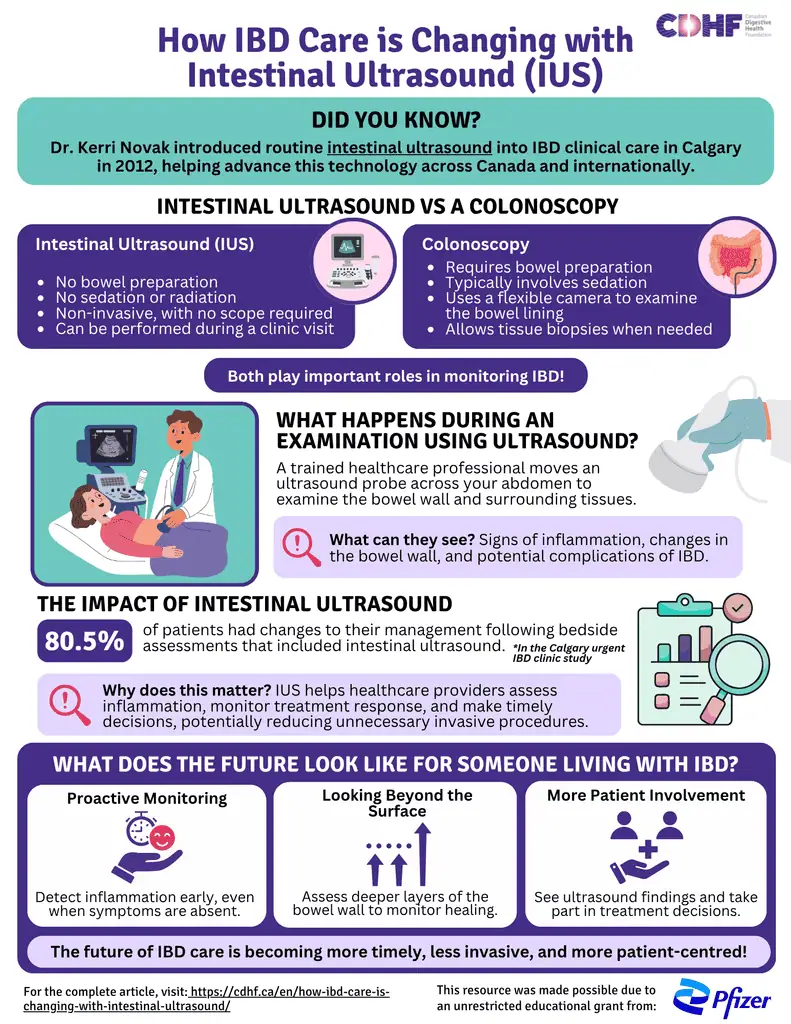
Intestinal ultrasound (IUS) is exactly what its name suggests: an ultrasound examination that allows healthcare professionals to look at the bowel from outside the body. Unlike a colonoscopy, there is no scope inserted into the digestive tract. There is no bowel preparation, no sedation, and no radiation exposure.
During an examination, an ultrasound probe is moved across the surface of abdomen. A trained clinician can assess the bowel wall and surrounding structures and look for signs of inflammation and complications.
The University of Calgary describes point-of-care ultrasound as a non-invasive way of evaluating both the small and large bowel. It can be performed in the clinic and repeated when necessary, making it particularly useful for monitoring disease over time. 2.
For patients, this can make an enormous difference. Instead of hearing about what might be happening inside their bowel based solely on symptoms or laboratory results, or an endoscopic examination they are asleep for, they can potentially have their bowel assessed during the appointment itself.
Turning an appointment into an opportunity for answers
One of the most important advantages of IUS is immediacy. Traditional IBD investigations can involve waiting for an appointment, undergoing a test somewhere else and then returning to discuss the results. IUS can bring part of that process directly into the consultation.
Dr. Novak and her colleagues have demonstrated the value of this approach in an urgent IBD setting. In a Calgary study of an IBD urgent assessment clinic, bedside intestinal ultrasound was incorporated into patient assessment to help physicians determine whether symptoms were associated with active inflammation and decide what should happen next. The study found that IUS improved clinical decision-making and resource utilization – fewer scopes, fewer imaging studies and fewer trips to the ER. 3
For a patient experiencing abdominal pain, diarrhea, or other concerning symptoms, this can mean an important change in the experience of care. Rather than simply asking, “Could this be a flare?”, the healthcare team may be able to gather objective information about the bowel during the visit. That can help separate active inflammation from symptoms that may have another cause.
Helping patients avoid unnecessary invasive procedures
Dr. Novak’s work became especially important during the COVID-19 pandemic, when avoiding unnecessary hospital-based procedures became a priority. At the University of Calgary, her team developed an acute IBD flare clinic that incorporated point-of-care intestinal ultrasound. The goal was to assess patients quickly while reducing the need for hospital-based endoscopy when it was not necessary. 2
In the published study of this approach, the Calgary team reported that access to immediate ultrasound and other bedside assessments resulted in management changes for 80.5% of patients. That does not mean every patient avoided an endoscopy, nor does IUS replace colonoscopy in every situation. Instead, the technology helped clinicians decide which patients needed further investigation, and which could be managed based on the information available at the bedside. 3
For patients, the potential benefit is substantial: fewer unnecessary trips to hospital, fewer invasive investigations, and faster decisions when symptoms appear.
Looking beyond symptoms
Perhaps one of the most important contributions of IUS is increasing recognition that IBD care needs to look beyond how a patient feels. Someone can feel well while inflammation remains active, unrecognized in the bowel and therefore progressing, towards potential bowel damage. Conversely, someone can experience abdominal symptoms such as pain and diarrhea, without having significant inflammatory activity.
That distinction matters because ongoing inflammation can contribute to bowel damage over time. IUS allows clinicians to look for objective evidence of inflammation and monitor how the bowel responds to treatment.
Dr. Novak has been involved in research and international efforts to standardize intestinal ultrasound assessment, including work developing reliable scoring systems for evaluating Crohn’s disease activity. 3. Intestinal ultrasound is being incorporated into clinical trials to test new drugs, using healing or response on IUS as an endpoint – exploratory for now, but likely an important measure in the future. This is a really positive step, as we work to make clinical trials more manageable and feasible for patients. Standardizing IUS measures helps to move IUS beyond simply being an interesting image on a screen in clinic. The goal is to make ultrasound measurements consistent and meaningful enough that clinicians can use them to guide patient care and guide response to much needed therapies for IBD.
Treatment can become a more interactive process
For patients, one of the most appealing aspects of IUS is its timeliness: IUS can make monitoring feel more immediate because it occurs during routine follow up. The important insights on IUS contribute to shared decisions made between the provider and you, the patient. For example, a new medication may be started with follow-up scheduled to understand the response to the new treatment. Rather than relying exclusively on symptoms, blood or stool tests or waiting for a future colonoscopy, the IUS can be used to measure response and establish evidence of improvement..
If there is reduced inflammation on IUS, this is objective reassurance. If inflammation is still present, a discussion about whether treatment needs to be adjusted can be had in a timely way – without delay.
This approach supports the broader IBD philosophy of treating inflammation proactively rather than waiting until symptoms become severe.
Dr. Novak has also contributed to research and clinical thinking around transmural healing—looking beyond the inner lining of the bowel seen on colonoscopy to assess whether deeper inflammation has resolved. IUS is particularly interesting in this context because it can visualize multiple layers of the bowel wall and surrounding tissues. 4
All of the monitoring tools have a place in a monitoring strategy – the important thing for patients, is for the tools to be easily repeated without a huge burden or risk, in a timely way, not adding significant delays. Although each test has its strength, IUS in combination with other non-invasive tests like fecal calprotectin could be the new standard to ensure the inflammation in the bowel is easily and comprehensively evaluated regularly.
Patients notice the difference
The potential benefits of IUS are not limited to clinical measurements. Patients themselves have described the experience as a major improvement. Patients have described having ultrasound available as a “huge improvement,” emphasizing that it was quick, easy and less invasive than a scope. They were able to look at their bowel during appointments and make treatment adjustments when needed. 2
That patient perspective captures something important about Dr. Novak’s approach.
Medical innovation is not only about whether a test produces accurate information. It is also about whether that test makes healthcare easier for the person receiving it.
For someone who has undergone multiple colonoscopies over the course of years, a quick, non-invasive examination can make the prospect of regular disease monitoring much less daunting.
From one Calgary clinic to an international movement
Dr. Novak’s influence extends well beyond her own patients. She is a founding member of the International Bowel Ultrasound Group (IBUS), is the current President of IBUS and a founding member of the North American group, iUSCAN. She with her growing cadre of colleagues in Calgary, Dr. Cathy Lu, Dr. Joelle St. Pierre, Dr. Jonathan Besney, Dr. Gilaad Kaplan and Dr. Richard Ingram are involved in training clinicians in the technique. SCOPE Canada describes her as an enthusiastic trainer of clinicians from around the world. 1
The Canadian Association of Gastroenterology has also highlighted the growing adoption of IUS in Canada, with adult and pediatric centres incorporating the technology into IBD care. 5 There is now increasing access to both adult and pediatric, expert IUS in many IBD-expert clinics across Canada, from British Columbia to Nova Scotia.
This is an important part of Dr. Novak’s legacy: she has not simply used IUS herself. She has worked to develop the evidence, standards and training needed to help other clinicians use it effectively. Her research has contributed to international efforts to establish standardized approaches for performing and interpreting intestinal ultrasound. 3
What does this mean for someone living with IBD?
It means that the future of IBD monitoring may look different from the past. Instead of every assessment requiring a complex sequence of tests, some patients may be able to have an ultrasound examination as part of their regular clinic visit.
Instead of waiting weeks or months for an invasive investigation, clinicians may sometimes be able to obtain useful information immediately.
And instead of treatment decisions being based primarily on symptoms, patients and healthcare professionals can increasingly combine symptoms with objective evidence of what is actually happening inside the bowel.
IUS does not eliminate the need for colonoscopy, MRI or other investigations. It is not appropriate for every situation, and its accuracy depends heavily on appropriate training and expertise.
A more patient-centred future
The story of intestinal ultrasound in Canada is, in many ways, a story about making IBD care more patient-centred. IBD-expert clinics across Canada are building this service to ensure patients have access to it. The potential of a technology that could bring the bowel into view without putting patients through another invasive procedure.
For patients, the result can be wonderfully practical:
- A test that takes place during a clinic visit.
- No bowel preparation.
- No radiation.
- No scope.
And, potentially, a much faster answer to one of the most important questions a person with IBD can ask: “What’s happening inside my bowel—and is my treatment working?”
That combination of convenience, objective information and patient involvement is what makes Dr. Novak’s work with intestinal ultrasound so significant. It is not simply about introducing a new medical technology. It is about making life with IBD a little less invasive, a little less uncertain and, ultimately, a little easier to manage.
Intestinal Ultrasound Video Reels by Dr. Kerri Novak
What is Intestinal Ultrasound (IUS) for IBD? (Part 1)
How Intestinal Ultrasound Helps People With and Without IBD
(Part 2)
IBD Intestinal Ultrasound in Clinical Practice (Part 3)
This resource was made possible due to an unrestricted educational grant from Pfizer.

References:
- SSCOPE CanadaOur Team | SCOPE Canada | Society for Continuing Professional Health Education (SCOPE) Canada
- CCumming School of MedicineInflammatory Bowel Disease Group | Cumming School of Medicine | University of Calgary
- PubMed Central (PMC)Bedside Intestinal Ultrasound Performed in an Inflammatory Bowel Disease Urgent Assessment Clinic Improves Clinical Decision-Making and Resource Utilization – PMC
- WWiley Online LibraryAlimentary Pharmacology & Therapeutics | Pharmacology Journal | Wiley Online Library
- CCAG ACGIntestinal Ultrasound (IUS) – Canadian Association of Gastroenterology










Infliximab for the Treatment of Inflammatory Bowel Disease: An Overview of Drug History and Delivery