Constipated From Medication? Causes, Treatments & What to Know

Written by: Jennifer House, MSc, RD
Updated: November 5th, 2026
Starting a new medication can improve your health, but sometimes it comes with the unexpected side effect of constipation. Whether you’re taking pain medication, iron supplements, or newer weight-loss medications, constipation is common.
The good news is that medication-related constipation can usually be managed. In this post, you’ll learn which medications are most likely to cause constipation and why, plus strategies that may help provide relief.
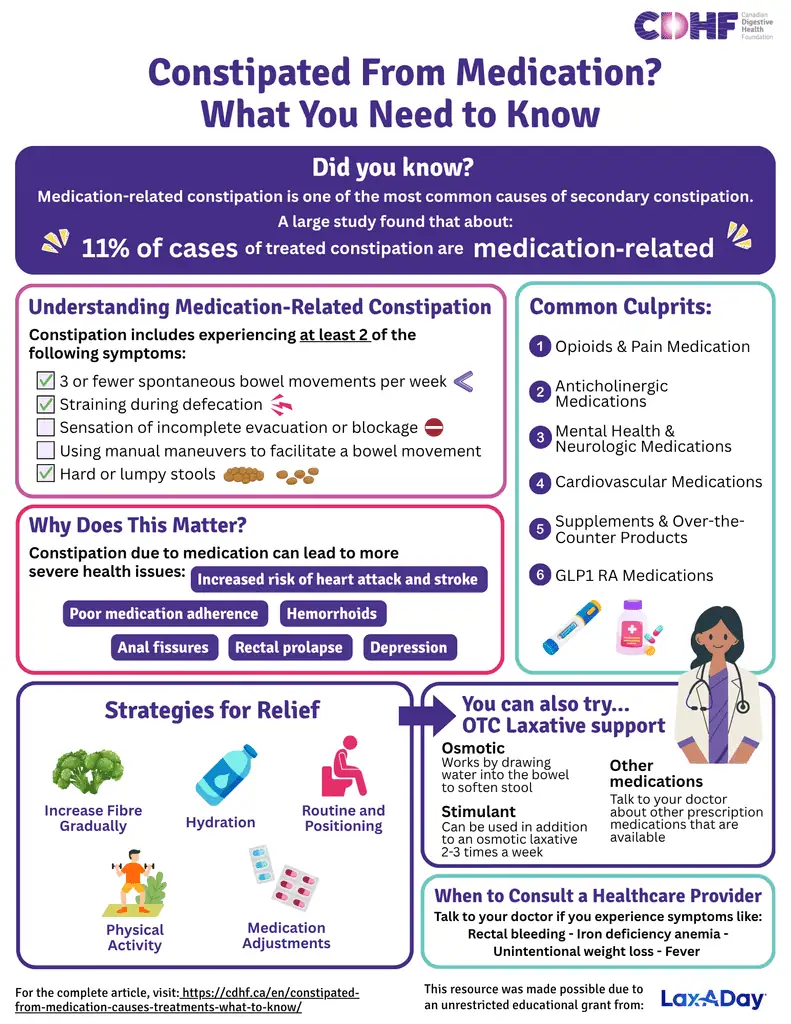
Understanding Medication-Related Constipation
Constipation is more than simply having fewer bowel movements. It includes experiencing at least two of the following symptoms:
- 3 or fewer spontaneous bowel movements per week
- Straining during defecation
- Sensation of incomplete evacuation or blockage
- Using manual maneuvers to facilitate a bowel movement
- Hard or lumpy stools
Why does this matter?
Constipation due to medication is not just uncomfortable. It can lead to more severe health issues, some of which may surprise you, such as:
- Poor medication adherence
- Hemorrhoids
- Anal fissures
- Rectal prolapse
- Depression
- Increased risk of heart attack and stroke
How common is constipation from medication?
Medication-related constipation is one of the most common causes of secondary constipation. A large study reviewing medical records in Japan found that about 11% of cases of treated constipation are medication‑related.
It is especially common among people taking opioid pain medication: about 22 to 81% of people taking these drugs can experience constipation.
And for those on Glucagon-like peptide receptor agonists (GLP-1 RAs), studies on those who have diabetes or obesity have found that up to 37% struggle with constipation.
Common Culprits
Medications can decrease gut motility, increase water absorption from the colon, and disrupt nerve pathways, leading to dry, hard stools.
Several types of medications can lead to constipation:
1. Opioids & Pain Medication:
Opioids are used for pain control. To a lesser extent, non-steroidal anti-inflammatory drugs such as ibuprofen can also be linked to constipation.
The narcotic effect of pain medication can also cause nerves in the gut to ‘sleep,’ which slows movement through the intestinal tract . This can lead to hard, dry stools which are difficult to pass.
2. Anticholinergic Medications
These are a large class of medications found in many over-the-counter and prescription medications, such as antihistamines, bladder antispasmodics for urinary incontinence, and some anti-nausea medications.
Anticholinergic medications block the effects of acetylcholine, a chemical that helps muscles move. This leads to reduced gut motility and, therefore, constipation.
3. Mental Health & Neurologic Medications:
These medications include antidepressants, antipsychotics, which may be used in schizophrenia, and Parkinson’s medications.
A lot of antidepressants that treat the nerve endings in the brain also affect nerve endings in the gut, again slowing movement and leading to constipation.
4. Cardiovascular Medications
Calcium channel blockers relax smooth muscles in the gut and can cause constipation.
5. Supplements & Over-the-Counter Products
Even regular food/dietary supplements or over-the-counter medications like iron and antacids are linked to constipation. They reduce intestinal transit time, resulting in harder, drier, and more difficult-to-pass stools.
6. Glucagon-like peptide-1 receptor antagonists (GLP1 RA)
GLP1 RAs are used to manage diabetes or support weight loss.
People taking these medications feel full, so they may decrease their fluid intake. GLP1 RAs also delay intestinal transit time and gastric emptying, reducing the overall speed of the digestive process.
Strategies for Relief
1. Fibre Intake:
Increase fibre gradually
The recommended total fibre intake for adults aged 19 to 50 years is 38 grams/day for men and 25 grams/day for women. And for adults over 50 years old: 30 grams/day for men and 21 grams/day for women.
Add fibre slowly to your diet to allow your system to adjust and avoid gas and bloating. And increase fluid intake along with fibre, to help push it through your intestinal tract.
Fibre Sources
In terms of fibre type, aim for more soluble fibre when struggling with constipation. It draws water into the digestive tract, making stool softer and easier to pass.
Soluble is preferred to insoluble fibre, which increases bulk and may be counterproductive when taking drugs that slow intestinal transit time and pull water from the stool.
Soluble fibre-rich foods to add:
- Roasted soy beans
- Kidney & Lime beans
- Squash (i.e. butternut or acorn)
- Brussels sprouts
- Pears
- Dried Figs
- Oranges
- Ground flax seeds
When fibre may not help
And bulk-forming fibre supplements, such as psyllium, may not be the most appropriate choice for people taking medications that slow bowel movements (particularly opioids). They can sometimes worsen abdominal pain.
It’s recommended to increase fibre intake with opioid use, only if dietary fibre intake is inadequate. And even an increase to recommended levels of 25 (for women) to 38 grams (for men) a day is not always indicated, due to slow transit time with opioid use.
One review even suggests dietary fibre intake should not be higher than 20 grams for those on opioids.
2. Hydration:
Staying well hydrated helps fibre work effectively and may reduce the risk of hard stools.
Here are the Canadian fluid guidelines, which recommend drinking about 13 cups (~3 litres) of fluid per day for men and 9 cups (~2.1 litres) for women.
3. Routine and Positioning:
Another lifestyle strategy to prevent and treat constipation is routine and positioning.
Establish a daily routine, and your body will get used to going to the toilet/bathroom at the same time each day. Listen carefully to your body’s signals and don’t ignore the urge to go.
And consider using a footstool for a squatting position to improve the angle, making it easier to pass a bowel movement.
4. Physical Activity:
If you are able, aim for at least 150 minutes of exercise per week. Regular movement may help keep your bowels moving too.
5. Medication Adjustments:
If you’re still having trouble with constipation due to medication after making the above changes, you might need to talk to your doctor about a change or decrease in medication.
For example, reducing the GLP-1 dose might be an option if it’s causing constipation. But never stop or adjust a prescription medication without speaking with your healthcare provider.
And if iron supplements are an issue, you can consider switching to a different formulation. Iron-induced constipation rates are high with traditional oral ferrous iron formulations such as ferrous sulphate, fumarate, or gluconate.
An alternative iron formulation may be more suitable, such as liposomal iron, which is released more slowly. Or microencapsulated iron, which requires a lower daily dose.
Over-the-Counter (OTC) Laxative Support
Osmotic Laxatives
If the medication you’re taking slows down transit or gut activity, an osmotic laxative, like Polyethylene glycol (PEG) or lactulose may help. They are often generally well tolerated and are available over the counter.
Osmotic laxatives work by drawing water into the bowel, softening stool and making it easier to pass. Lactulose is less suitable than Polyethylene glycol (PEG) in opiod-induced constipation, because while it is effective, it tends to cause more gas and bloating than PEG.
PEG and lactulose are the only laxatives proven to work better than a placebo in improving symptoms of opioid-induced constipation in research.
Stimulant Laxatives
Stimulant laxatives (like Senna) can be used in addition to an osmotic laxative, two or three times weekly if osmotic laxatives aren’t doing enough to help. Note that the usefulness of stimulant laxatives tends to decline with long-term use, and they can cause intestinal pain.
Other Medication Options
Talk to your doctor about other prescription medications that are available to help with constipation, if OTC options don’t provide enough relief. For example, opioid antagonists like PAMORAs (which stands for ‘Peripherally acting -opioid receptor antagonist’).
When to Seek Medical Attention
Talk to your doctor if you experience symptoms like:
- Rectal bleeding
- Iron deficiency anemia
- Unintentional weight loss
- Fever
Your doctor may recommend a colonoscopy or additional imaging to rule out more serious causes.
Key Takeaways
Medication-related constipation can be frustrating, but it doesn’t have to become your new normal. Small changes can make a big difference, such as drinking enough fluids, choosing the right types of fibre, and reviewing your medications with your doctor. Always consult with healthcare professionals for personalized advice.
This article is sponsored by Lax-A-Day® a registered trademark owned by Norwell Consumer Healthcare Inc. This product may not be right for you. Always read and follow the label.

References
- Al Alawi, A. M., Al Nou’mani, J., Al Abri, N., Al Sabbri, M., & Al-Maqbali, J. S. (2024). Impact of Constipation on Health Outcomes in Medically Hospitalized Patients: A Prospective Study on Laxative Use and Health Care Outcomes. Medicina (Kaunas, Lithuania), 60(10), 1599. https://doi.org/10.3390/medicina60101599
- Alberta Health Services. (2020). Chronic Constipation Primary Care Pathway. https://www.albertahealthservices.ca/assets/about/scn/ahs-scn-dh-pathway-constipation.pdf
- Alberta Health Services, Nutrition Service. (2025). Eat More Soluble Fibre. https://www.albertahealthservices.ca/assets/info/nutrition/if-nfs-eat-more-soluble-fibre.pdf
- De Giorgio, R., Zucco, F. M., Chiarioni, G., Mercadante, S., Corazziari, E. S., Caraceni, A., Odetti, P., Giusti, R., Marinangeli, F., & Pinto, C. (2021). Management of Opioid-Induced Constipation and Bowel Dysfunction: Expert Opinion of an Italian Multidisciplinary Panel. Advances in therapy, 38(7), 3589–3621. https://doi.org/10.1007/s12325-021-01766-y
- Gorgojo-Martínez, J. J., Mezquita-Raya, P., Carretero-Gómez, J., Castro, A., Cebrián-Cuenca, A., de Torres-Sánchez, A., García-de-Lucas, M. D., Núñez, J., Obaya, J. C., Soler, M. J., Górriz, J. L., & Rubio-Herrera, M. Á. (2022). Clinical Recommendations to Manage Gastrointestinal Adverse Events in Patients Treated with Glp-1 Receptor Agonists: A Multidisciplinary Expert Consensus. Journal of clinical medicine, 12(1), 145. https://doi.org/10.3390/jcm12010145
- Hanson, B., Siddique, S. M., Scarlett, Y., Sultan, S., & American Gastroenterological Association Institute Clinical Guidelines Committee (2019). American Gastroenterological Association Institute Technical Review on the Medical Management of Opioid-Induced Constipation. Gastroenterology, 156(1), 229–253.e5. https://doi.org/10.1053/j.gastro.2018.08.018
- Karasawa, Y., Nozawa, K., & Nakajima, A. (2024). Potential drug-induced constipation: A retrospective study using a Japanese claims database. JGH open: an open access journal of gastroenterology and hepatology, 8(2), e13036. https://doi.org/10.1002/jgh3.13036
- National Academies of Sciences, Engineering, and Medicine. (2005). Dietary Reference Intakes for Water, Potassium, Sodium, Chloride, and Sulfate. The National Academies Press. https://doi.org/10.17226/10925.
- Qi, X., Zhang, Y., Guo, H., Hai, Y., Luo, Y., & Yue, T. (2020). Mechanism and intervention measures of iron side effects on the intestine. Critical reviews in food science and nutrition, 60(12), 2113–2125. https://doi.org/10.1080/10408398.2019.1630599
- Squeo F, Celiberto F, Ierardi E, Russo F, Riezzo G, D’Attoma B, Di Leo A, Losurdo G. Opioid-induced Constipation: Old and New Concepts in Diagnosis and Treatment. J Neurogastroenterol Motil. 2024 Apr 30;30(2):131-142. doi: 10.5056/jnm23144. PMID: 38576366; PMCID: PMC10999847.
- Qi, X., Zhang, Y., Guo, H., Hai, Y., Luo, Y., & Yue, T. (2020). Mechanism and intervention measures of iron side effects on the intestine. Critical reviews in food science and nutrition, 60(12), 2113–2125. https://doi.org/10.1080/10408398.2019.1630599